
WONDERING WHY "BABBLING BROOK" HAS BECOME A TRICKLE?
BLAME IT ON CONRAD VEIDT

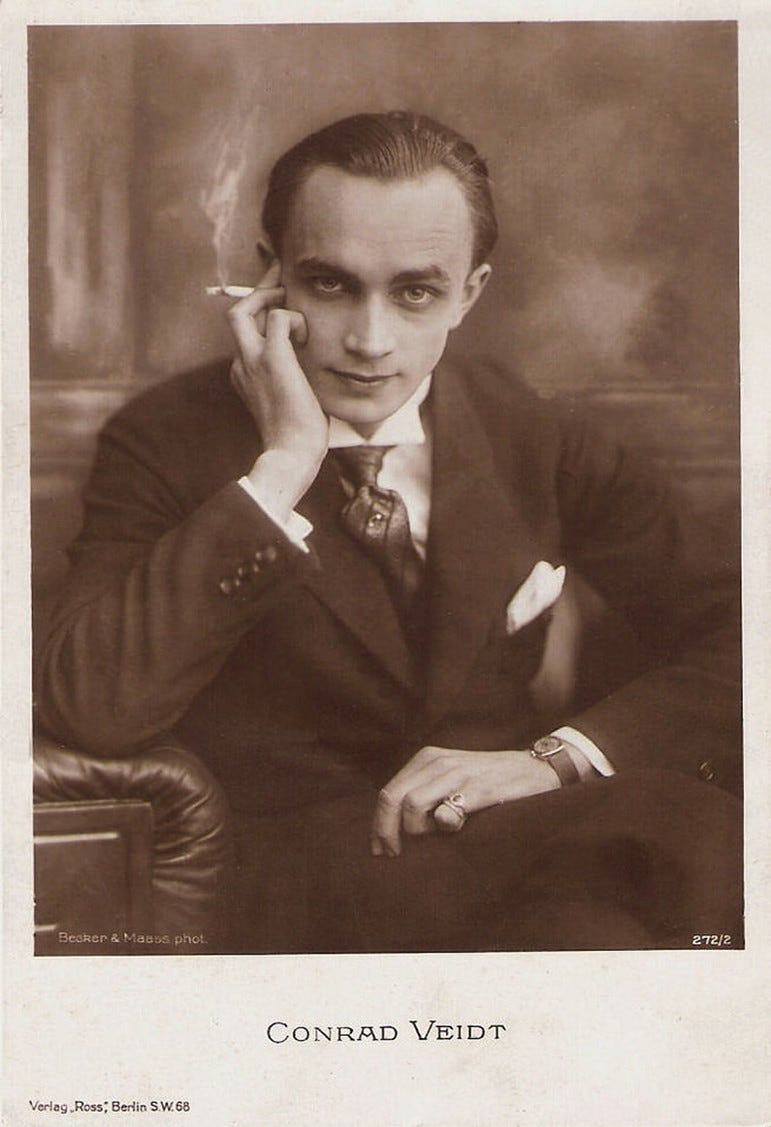
Portrait by Marie Boehm / Becker & Mass, 1919 (Public Domain)
Conrad who?—you might ask. And you’re not alone. If I mention he plays the Nazi major shot by Bogie’s Rick Blaine at the end of Casablanca, I’ll get a few nods. But the actor’s name remains a mystery to most filmgoers today.
Though not to Rabbi Chava Bahle and me, who are in the final editing stages of her book Moral Courage and Moral Imagination in Dangerous Times: Conrad Veidt, An Ethical Biography. Which is why I’ve been a bit lax in my blog-posting of late—certainly not for any lack of material to fulminate about, but because I believe Veidt’s story is an important one.
Conrad Veidt (aptly pronounced “fight” in German) starred in 1919 in the first major gay rights film, Anders als die Andern (Different from the Others), when homosexuality was strictly verboten in Germany, as it would be in the US until the Lawrence v. Texas decision in 2003.
He helped launch the Expressionist film movement of the 1920s with his mesmerizing performance in The Cabinet of Caligari, which catapulted him to international stardom.
Weimar-era cultural influencers Klaus and Erika Mann said that no actor “was as popular as Veidt in interwar Germany.”[1] The legendary John Barrymore begged him to co-star with him in Hollywood. And famed British director Michael Powell felt privileged to land him as a lead because, for Powell and his screenwriting partner Emeric Pressburger, Conrad Veidt “was German cinema!”[2]
From his adoring fans, Veidt’s in-person appearances occasionally led to mob scenes of Beatlemania proportions.[3] And when he invariably had to meet a bitter end playing diabolical Nazis in wartime US films like Casablanca, his diehard fans formed a “Keep Veidt Alive on Screen” club and inundated the studio with postcards to that effect.
But Veidt’s critical acclaim and popular appeal are only half the story.
His humanitarian side had been evident since Anders als die Andern and in other German Aufklärungsfilme (educational films), as well as in his sensitive portrayals of people with disabilities. And after fleeing Nazi Germany for the UK in 1933 with his Jewish wife, Lily, the non-Jewish Veidt made two films in short order, The Wandering Jew and Jew Süss, both aimed directly at Hitler and antisemitism.
And it’s for this ceaseless dedication to social justice and bold resistance to tyranny until his death in 1943, that Chava’s book, besides drawing renewed attention to Conrad Veidt as an actor auteur, also holds him up as a morally courageous model for our own soul-trying times.
So, until Veidt’s ethical biography is on the road to publication, please forgive Babbling Brook’s brief lapse in anti-Trump resistance, have a Happy Halloween, and above all, let’s give it to the neo-fascist lunatic on No Kings Day!

Veidt as the disfigured Gwynplaine in Universal Pictures’ “The Man Who Laughs,” 1928 (Public Domain)
* * * * * * * * * *
NOTES
[1] Elizabeth Otto, “Schaulust: Sexuality and Trauma in Conrad Veidt’s Masculine Masquerades,” in Christian Rogowski, ed., The Many Faces of Weimar Cinema: Rediscovering Germany’s Filmic Legacy (Camden House, 2023).
[2] Michael Powell, A Life in Movies: An Autobiography (Knopf, 1987), 304–305.
[3] “Gallery Girls Thrown Out When They Gate-Crashed Foyer To Mob Conrad Veidt,” The Dailey Mirror (of London) headline, 1936.
Thanks for your kind and complimentary words, Chava. But don’t sell yourself short. The book is your baby, and you did the bulk of the child-tearing in bringing them to adulthood.
I adore Veidt and look forward to the book you are working on with Chava Bahle. I especially love the detail that fans created a "Keep Veidt Alive on Screen" club. As I have heard the tale, Veidt himself insisted that any Nazi character he plaid should meet a terrible end. I enjoy him so much in early Weimar films, and he was fun to watch in Cukor's A Woman's Face opposite Joan Crawford! Gwynplaine forever! <3