
INDIGENOUS DISINFORMATION
MARS AN OTHERWISE ENTERTAINING ARTICLE

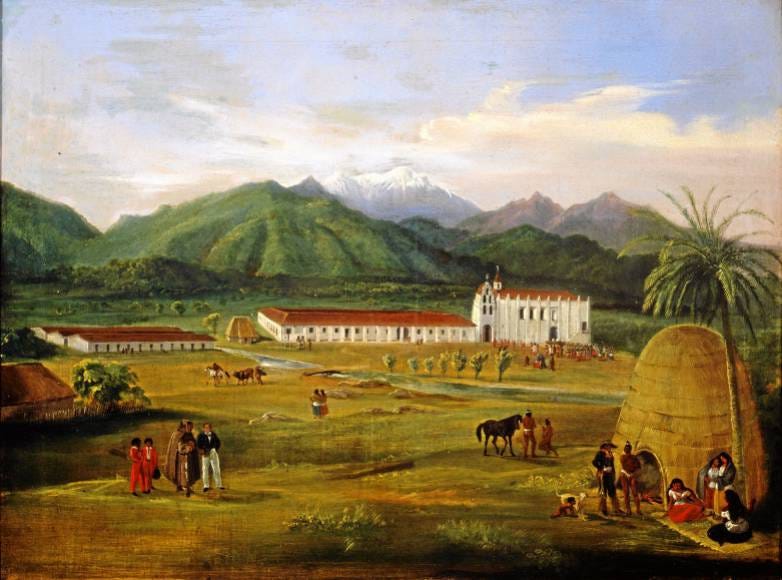
Painting of Mission San Gabriel Arcángel by Ferdinand Deppe (1832) with a Tongva thatched hut called a kizh (pronounced “keech”) to the far right (Public Domain)
(Disclaimer: I’m not of Native American descent. But I’ve interviewed many indigenous people from the Los Angeles area, have attended some of their events, and have written about these experiences in my 2013 nonfiction book “Land of Smoke and Mirrors: A Cultural History of Los Angeles” and my October 28, 2023, blog “Tongva vs. Kizh: The Battle for the Name of L.A.’s Indigenous People.” Also, for convenience, I generally refer to the predominant indigenous tribe in the Los Angeles basin historically and presently as the Tongva people, rather than by their oft-used and legitimate variations such as Kizh, Gabrieleño, or Gabrielino.)
As someone who grew up in the San Fernando Valley and watched my family’s vintage Spanish-style house with a chicken farm and an apricot orchard razed in the 1960s to make way for a Starbucks, I can well relate to Emmett Rensin’s love-hate take on the Valley in his “Where I’m From” article about growing up in the 1990s/2000s in the mega-suburb of now close to 2 million people.[1]
The article begins beautifully, with a poetic description of the Valley’s geological formation: “Like a cupped hand plunged beneath the water, coming up: a ring of hills and mountains and a bowl between them, quivering with sediment, seawater, and muck. The fingers rise and the palm sinks. Are still sinking, still rising . . . .”
And the bulk of what follows, about Rensin’s Valley Boyhood, is a breezy read.
Unfortunately, and right off the bat, a few erroneous assertions or oversimplifications pop up about the first indigenous people to settle in the Valley—one of which is quite unsettling and behooves me to set the record straight.
Let’s start with the lesser blunders, which occur in the middle of the third paragraph:
“In what is now Nevada a band of Uto-Aztecans break off from their friends and travel west, settling along the tributaries and springs inside the [Valley] basin. They called themselves the Tongva, or the Achooykomenga, which doubles as the name of their new home, the ones who face the sun.”
Though estimates vary, the Chumash people clearly had entered the Valley from the west well before the Tongva, and the Tataviam had arrived from the north either earlier or concurrent to the Tongva.[2] And while the Tongva were also known as the Achooykomenga, this was only a local appellation associated with a settlement at the later founded Mission San Fernando Rey de España. In general, the Tongva were known less by their pan-tribal name than by that of their particular village, which numbered close to 100 and lay mainly south and east of the Valley, extending to the Pacific Coast and the Southern Channel Islands, to Downtown and West LA, and to the San Gabriel Valley.[3]
This vast expanse is illustrated in the sacred sites that have been reconsecrated in recent years: in Downtown LA, Long Beach, Playa Vista, West LA, Seal Beach, and Newport Beach, as well as one in the Valley commemorating “a cultural crossroads” of the Fernandeño-Tataviam and Fernandeño-Tongva (the Spanish name given to both upon their joint consignment to Mission San Fernando) and the Barbareño- and Ventureño-Chumash (hyphenated due to their connections to Mission Santa Barbara and Mission Basilica Buenaventura.)[4]
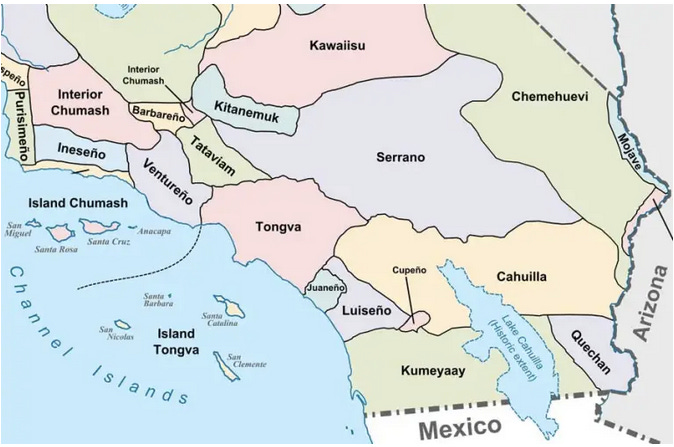
“Southern CA Native American Tribal Territories,” 2022 (courtesy Native Land [.CA] 501c3)
Okay, so Rensin was playing it a bit fast and loose with the Tongva band’s proprietary claims to the Valley. But then, at the bottom of paragraph 3, he went whole hog in the opposite direction.
“Smallpox, flu, and baptism by water, iron, fire: by 1826, no Tongva left . . .” (Emphasis mine)
Rensin is too intelligent to have meant that all the Tongva literally vanished from the face of the earth. For while Spanish-bred disease, harsh mission conditions, and even harsher post-mission treatment in the Mexican and early American periods devasted the indigenous populations—estimates range from a 30 to 50% reduction of the California native population by the American period and up to 80% thereafter—this still left more than a few living and breathing Tongva out of the estimated 5-10,000 people who’d inhabited the region prior to the European invasion.[5]
But if even if Rensin “only” implied that the ordeals of their mission enslavement and renaming totally deracinated the Tongva people—try telling their 1000s of living descendants today (close to 4,000 registered members as of 2013), still struggling for respect and recognition, that their ability to claim Tongva ancestry was expunged for all time two centuries ago![6]
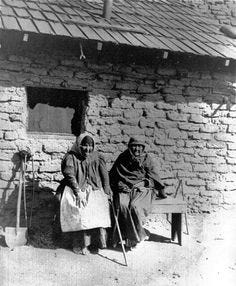
Two Tongva women at Mission San Fernando, 1890 (author unknown, Public Domain)
First off, many Tongva had resisted deracination already during the mission period and continued to do so afterward, retaining traditional practices and returning to their villages.[7]
A more shameful corollary to Rensin’s claim, however, is its reviving the “no more left” calumny the Tongva had been subjected to since the early 1900s and modern-day Tongva thought had finally been laid to rest.
In reaction to the “Kill the Indian, Save the Man” strategy of the American-era boarding schools where native children were punished for claiming to be “Indian,” the Tongva resorted to publicly identifying as Mexican, learning Spanish, and adopting Catholicism while keeping their indigenous identity a secret.[8]
And so began the extinction myths.
In 1921, the Los Angeles Times headlined the death of José de los Santos Juncos, the purported last member of the area’s Gabrieleño Indians (from their affiliation with Mission San Gabriel Arcángel), lamenting that “with him died the last vestige of personal remembrance of the golden age of the California Missions and the passing of a vanished race.”[9]
In 1925, noted cultural anthropologist Alfred Kroeber added scholarly patina, unequivocally declaring that the Gabrieleños were extinct, having “melted away so completely that we know no more of the finer facts of the culture of ruder tribes.”[10]
Ouch!
And the insults continued. A modern-day Gabrieleño, Bea Alva, recalled that the leader of a Labor Day parade in the 1950s had echoed the “vanished race” claim, and another tribal member, Denise Martinez, remembered being scolded by her 4th-grade teacher in the 1980s when Denise said she was Native American: “You live in a house, you wear clothes, so you can’t be an Indian!”[11]
And now in 2026, albeit with no malice aforethought, Emmett Rensin has once again lowered the boom.
Curious, actually, given his impressive and sympathetic credentials, which according to his Wikipedia entry include: American essayist and political commentator who writes from a leftist perspective, founding member of the award-winning Chicago First Floor Theater, and current contributing editor to the Los Angeles Review of Books. Perhaps his now living in Queens, according to the dispatch.com website for which he wrote his Valley article, explains Rensin’s seeming unawareness of—
THE TONGVA REVIVAL
Several Tongva organizations have emerged since the 1980s, referring to themselves as either Gabrieleño Tongva or Gabrieleño Kizh—kizh being what many of the Spanish had called the Tongva, based on the name for their thatched huts, as seen in the painting at the top.
While few records of the Tongva language and culture have been preserved, Loyola Marymount University has mounted an extensive collection of archival materials related to Tongva history, language revitalization classes have been developed, and Tongva is now spoken at public discussions and ceremonies, such as those mentioned above and others below.[12]
A summit in the Verduga Mountains in Glendale was named Tongva Peak in 2002. Claudia Jurmain and William McCawley contributed their groundbreaking history O My Ancestor: Recognition and Renewal for the Gabrielino-Tongva People of the Los Angeles Area in 2009 (Gabrielino being an early Americanization of Gabrieleño). I did my bit with Smoke and Mirrors: A Cultural History of Los Angeles in 2013, the same year that Tongva Park in Santa Monica was dedicated. And a one-acre site in Altadena was set aside as a Tongva homeland in 2022.
State recognition of both the Gabrieleño and Fernandeño Tongva tribes has also been achieved, but the grand prize of federal recognition remains elusive, largely due to dissention in the ranks between the Tongva- and Kizh-named groups and on whether or not, once federal recognition is secured, to build a casino.[13]
What the Tongva, Kizh, Gabrieleño or any combination thereof don’t need is somebody claiming once again that they don’t even exist!
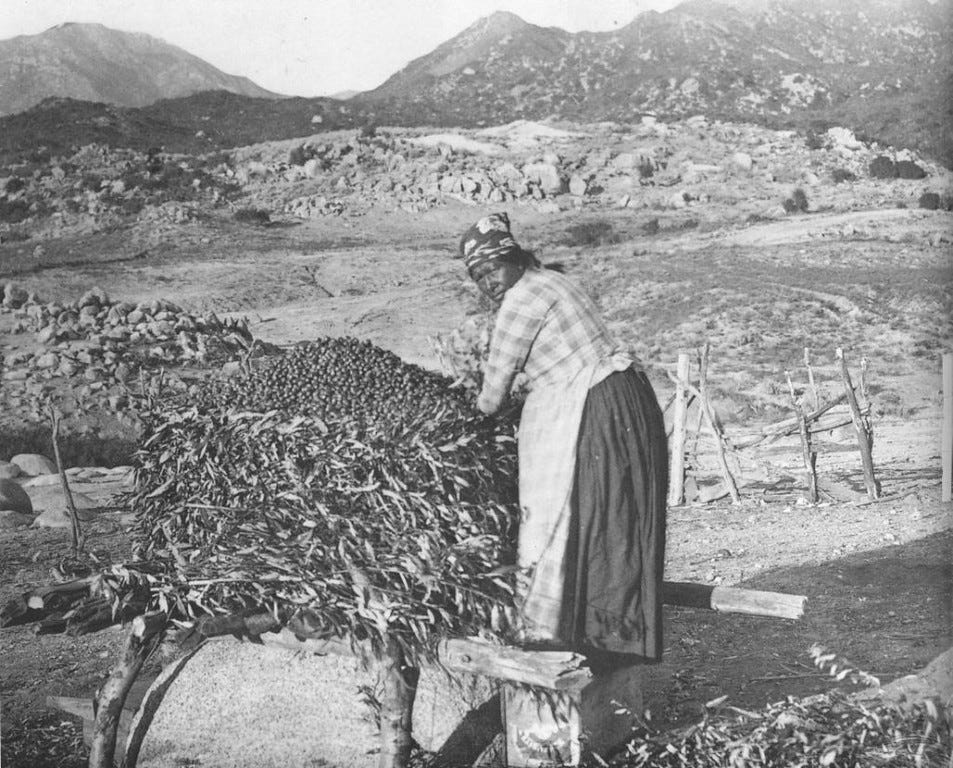
A Gabrieleño Mission Indian woman filling a granary with acorns, c. 1898 (photo by Cacaiste, California Historical Society Collection at the University of Southern California Libraries, Public Domain)
* * * * * * * * *
NOTES
Thanks to my good friends Tom Pfister and Chava Bahle: to Tom for making me aware of the Emmett Rensin article and to Chava for her usual wise counsel.
[1] Emmit Rensin, “The Valley! The Valley! The San Fernando Valley!” https://thedispatch.com/article/san-fernando-valley-smoke-rain-driving.
[2] On the Chumash: https://greatwallinstitute.sparcinla.org/virtual-tour/indigenous-california; on the Tongva: https://ericbrightwell.com/2022/10/23/no-enclave-tongva-los-angeles; on the Tataviam: https://www.tataviam-nsn.us/heritage/history.
[3] John Dietler, Heather Gibson, and Benjamin Vargas, “‘A Mourning Dirge Was Sung’: Community and Remembrance at Mission San Gabriel,” Forging Communities in Colonial Alta California (University of Arizona Press, 2018)
[4] https://www.gabrieleno-nsn.us/post/sacred-sites-of-the-gabrieleno-tongva.
[5] On the state population stats: Brian T. McCormack, “Conjugal Violence, Sex, Sin, and Murder in the Mission Communities of Alta California,” Journal of the History of Sexuality 16, no. 3 (December 4, 2007): 391–415; on mission mistreatment, Gregory Orfalea, August 31, 2015, https://www.commonwealmagazine.org/hungry-souls; on the Tongva population: https://www.indigenousmexico.org/articles/the-native-roots-of-southern-californian.
[6] Lauren Gold, “Mission Impossible: Native San Gabriel Valley Indians seek U.S. recognition,” San Gabriel Valley Tribune, August 8, 2020.
[7] Dietler, et al., A Mourning Dirge.
[8] Ward Churchill, Kill the Indian, Save the Man: The Genocidal Impact of American Residential Schools (City Light Books: 2004); on secret assimilation: A People's Guide to Los Angeles (University of California Press: 2012), 71; on Tongva student treatment: Gloria Arellanes, The Chicano Generation: Testimonios of the Movement (University of California Press, 2015), 116–117,
[9] Claudia Jurmain and William McCawley, O, My Ancestor: Recognition and Renewal for the Gabrielino-Tongva People of the Los Angeles Area (Berkeley, CA: Heyday, 2009), 5.
[10] Heather Valdez Singleton, “Surviving Urbanization: The Gabrieleño,” Wíčazo Ša Review. 19 (2), 2004: 49–59.
[11] Jurmain and McCawley, O My Ancestor, 38, 181-182.
[12] Jana Fortier (December 2008). “Native American Consultation and Enthusiastic Study, Venture County, California,” La Jolla, California: California Department of Transportation: 13–14.
[13] On the state recognition: Oropeza. “SB 1134 Senate Bill - Introduced, www.leginfo.ca.gov, www.leginfo.ca.gov, March 4, 2016; on the modern-day intra-tribal conflict: Vincent Brook, Land of Smoke and Mirrors: A Cultural History of Los Angeles (Rutgers University Press, 2013) and Vincent Brook, Tongva vs. Kizh: The Battle to Name L.A.’s Indigenous People, October 28, 2023, https://www.babblingbrook.substack.com/p/tongva-vs-kizh.
I respect your view and took it in my Oct. 28, 2023 blog. But after reading that several more informants supported Merriam’s claim, I was swayed enough to take that tack this time around. But I may swing back to your camp next time. My main point of course was to take Rensin to task for his reviving the extinction myth!
Sorry Vincent but you're way off base on the Tongva. Next time ask them for their genealogy. You'll find that a majority of their membership do not descend from the Indians at the Mission San Gabriel but the Kizh do, 88% and counting. The proof is in the 1770's Mission records but because the tribal name of Tongva was created in 1992, you probably wouldn't find them at all.