
DOUBLE EXPOSURE—SQUARED, Part 1
"Finding Vivian Maier" and "Three Minutes: A Lengthening"

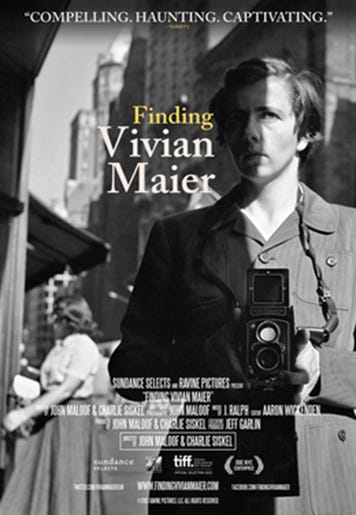
IFC Films (Fair Use)
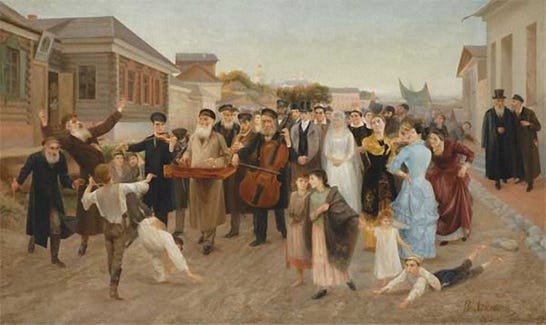
A Jewish wedding in a Shtetl, 1893, by Isaak Asknaziy (Public Domain)
(If you’re spoiler-warry, be forewarned)
Exposure: 1) the state of being exposed or revealed; 2) the action of exposing a photographic film to light or other radiation. Double exposure: two different exposures or images layered on top of each other.
All motion pictures are “exposure” films, in both senses. They expose or reveal a person, place, event, or idea for the first time or from a new perspective; and they’re created through their filmic material’s exposure to light. The two documentaries on display here, however—John Maloof and Charley Siskel’s Finding Vivian Maier (2013) and Bianca Stigter’s Three Minutes: A Lengthening (2023)—are “Double Exposure” films, with a capital D and E.
They both deal with photography—one with still photographs, the other with a motion picture. They both begin with a surprising discovery, which generates further discoveries. These various discoveries are layered on top of each other. And, I hope to show, the two documentaries themselves can be layered on top of each other, to extraordinary effect.
Double Exposure is embedded in Finding Vivian Maier’s very title, in the ambiguous reference to “findings” from and about Vivian Maier (pronounced Meyer). The finding from occurs right off the bat, when Maloof stumbles upon Maier’s treasure trove of photographic negatives in boxes he purchased for $380 at a Chicago auction house in 2009, shortly after Maier’s death at age 83. He’d hoped to find a few old photos of the city to use in a history book he was writing.
Talk about unintended consequences!
As Maloof begins scanning Maier’s reams of negatives and piles of undeveloped camera rolls—over 140,000 images in all—he immediately senses that the photographs are far from ordinary. And the noted professionals to whom he shows Maier’s work agree, comparing it favorably to that of superstars Robert Frank, Lisette Model, Helen Levitt, and Diane Arbus. And yet, photographer Ellen Mark opines, given Maier’s choosing to leave her vast body of exceptional work unprinted and tucked away: “Something’s wrong. A piece of the puzzle is missing.”
Cue the finding about: Maloof’s quest to reveal the woman behind the masterworks—through which, astonishingly, he learns that Maier had worked as a nanny most of her life, and gains access to several of her past employers and the now grown children she once cared for.
The families’ initial descriptions of Maier are what one might expect, given her remarkable photographs, largely of street people, and her equally remarkable disinterest in presenting her work to the world. “Paradoxical, bold, mysterious, eccentric, private,” are the picture they give of her, which meshes with the sundry self-portraits she made.
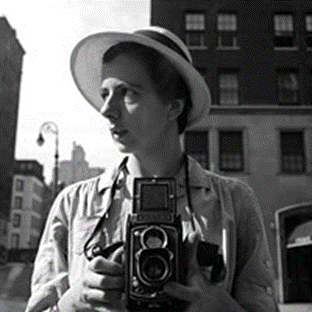
One of Vivian Maier’s many self-portraits (Fair Use), as is the poster image above
Some family members point to the ethical pitfalls of Maloof’s Double Exposure. About his publicizing Maier’s photographs, one woman chides, “She wouldn’t have let this happen.” “That was her baby,” scolds another. “She wouldn’t have put her babies on display.” And when Maloof finds another piece of the puzzle—a French village named Saint-Bonnet-en-Champsaur where Maier’s mother was from, where she herself lived when she was young, and which she visited as an adult—the second woman lays it on thick: “She might’ve been offended that you found her little town, that this was none of your business! ‘Oh my God!’ she would’ve said. ‘Why did you do this?’”
But Maloof, who admits early on to feeling “a little uncomfortable and guilty,” also strongly believes, “I was uncovering an artist!” and “to leave this giant boulder unturned, not to go there, would be a mistake!” And, indeed, it would’ve been, given what emerges from his visit, and combined with a letter he finds that Maier had written in French to the owner of a photo lab in the region, more than redeems Maloof’s “overwhelming curiosity.”
In the letter Maier praises the lab owner’s work on the postcards he’d made from her photos of the French countryside during her visit. Now she wonders—though “I’m very difficult, as you no doubt know”—whether he might be willing to make some prints from the “piles of great shots that I took with my new Rolleiflex camera since my return to the United States. And they’re not so bad, if I say so myself, and when I say piles, I mean I have a huge pile.”
With this stunning new evidence that, contrary to expectations, Maier was both aware of her talent and wanted her work to be seen, Maloof goes full speed ahead in getting as many of her photographs printed as possible. As for getting them shown, he runs into a roadblock with the “established art world,” based on the criterion that the works must have been printed by the photographer, not “interpreted” by someone else. This despite the fact that major museums have accepted photographs by several famous artists (Garry Winogrand, Eugene Atget, Henri Cartier-Bresson, Robert Frank), whose work was printed posthumously or who’d long had others print their work for them! (Gender bias, anyone?)
Back on the investigative trail, Maloof’s interviews with Maier’s nanny charges also take a downward turn. Earlier, the impression had been given that Maier “loved the children and the children loved her,” that “the children worshipped her,” and that “she loved them as much as she loved anybody.” Now what we hear from some of the grown children paints a far darker picture, layered on top of the brighter one.
“She was mean!” says one young man, and his sister recounts how Maier “ditched us,” and the police had to come pick them up, and how another child was locked in a basement with the lights out. Two other sisters claim Maier dragged them, one of them literally, into the slums, and that they felt she also mistreated her photographic subjects—embarrassing, imposing on, mocking them in some way. The harshest condemnation comes from one of the sisters who reluctantly opens up about how she was physically abused by Maier: repeatedly slammed against the walls, and force-fed—held down and choked until she swallowed her food.
Maier obviously wouldn’t have wanted this information disclosed. But here Maloof and Siskel side ethically with her youthful victims rather than with the prodigious exploits of the genius artist. Cancel culture, they fortunately forego. Indeed, the film ends on a series of highly successful gallery exhibits of Maier’s work in major cities around the world, and in a special exhibit in Saint-Bonnet-en-Champsaur, where residents are thrilled to recognize themselves in Maier’s photographs from long ago.
Nor are the grown children she mistreated wholly resentful. Several comment on Maier’s extreme hatred and fear of men, and how they now “have a lot more empathy for her,” seeing that she was “incredibly misunderstood,” and that her abusive behavior must have been rooted in her having herself been “brutalized or molested in some way.” Their parents didn’t realize what the children did, one of them summarizes. “She was living with mental illness. It was more than a little eccentric.”
Unable to hold down a job in her later years, Maier is rescued by some of the kids who adored her. They find her an apartment and pay the rent, and when she dies destitute and alone, they bury her in the woods near their old house, beside the patch of wild strawberries that she loved.
**********************************
MUCH MORE TO COME IN “DOUBLE EXPOSURE—SQUARED, Part 2.”