
BOMBS and BOMBSHELLS
"OPPENHEIMER" and "BARBIE"

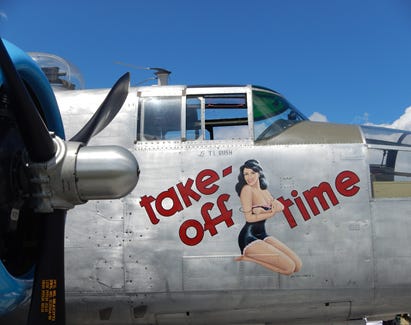
Pin-up Girl on a restored World War II B25J aircraft (photo Surfsupusa)
(If you’re spoiler-wary, be forewarned)
If one accepts Freud’s notion that Thanatos and Eros (Death and Sex, aka the Death Wish and the Pleasure Principle) undergird all human existence, it shouldn’t come as a surprise that “bombshell,” a slang term for a woman of exceptional allure, should have been coined during World War II just as the atom bomb was under construction.
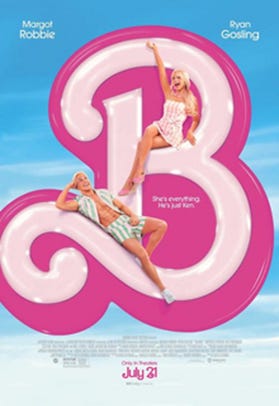
Warner Bros. Pictures
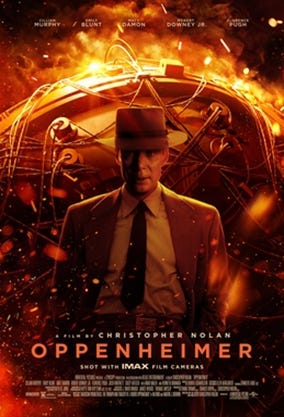
Universal Pictures
Granted it’s not nearly as earthshaking, but it’s certainly titillating that Barbie and Oppenheimer—one about a blonde bombshell, the other about “the father of the atomic bomb”—were released concurrently, became the summer’s 2 biggest blockbusters, and have been conjoined in the popular imagination as “Barbenheimer.” Clearly more than just a clever portmanteau that combines a comedy/fantasy and a cerebral docudrama is at play here. Or again, as Freud observes in Jokes and Their Relation to the Unconscious, humor often reveals what’s repressed in more serious comments.
Stanley Kubrick certainly grasped the sexual connotations of nuclear weapons in his 1964 satire Dr. Strangelove or: How I Learned to Stop Worrying and Love the Bomb, when in the film’s climax (pun intended), Air Force pilot T. J. “King” Kong (Slim Pickens) rides an H-bomb like a giant phallus/rodeo bronc as it makes its doomsday descent to the Soviet Union. And in case you didn’t get the dirty joke, the film culminates with an orgasmic montage of nuclear blasts billowing upward to Vera Lynn’s rendition of “We’ll Meet Again.”
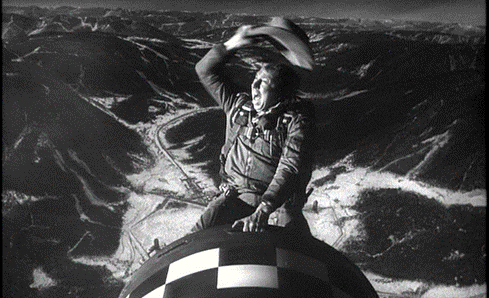
Kong’s ride to end all rides in “Dr. Strangelove” (Frame Grab)
But the Kubrick connection to Barbenheimer doesn’t end there.
Barbie co-writer/director Greta Gerwig returns the favor in her film’s opening: a parodic homage to Kubrick’s classic “The Dawn of Man” sequence in 2001: A Space Odyssey, which rightfully can be dubbed “The Dawn of Woman.” Like Kubrick’s prehistoric apes foraging for scraps on the African plains, Gerwig’s little girls are playing sexist roles with baby dolls until—like the obelisk that sparks the apes’ evolutionary leap, a giant Barbie doll appears to spur the girls’ giant step forward.
But within this in-joke lies a disturbing message. For just as “The Dawn of Man” ends on a slow-motion shot of an ape ecstatically tossing skyward the bone he’d just used to kill a rival ape, with the bone, at its peak, cutting to a futuristic spaceship circling the globe—“The Dawn of Woman” ends with a slow-motion shot of a girl ecstatically tossing skyward the only doll she hadn’t smashed to bits, with the doll, at its peak, cutting to the Barbie logo and the opening credits.
Clever and amusing, to be sure, but with the dark subtext that behind humanity’s technological and cultural progress lies weaponry and violence. Granted again that the dynamic new children’s toy that Mattel shattered hidebound tradition to produce can scarcely be likened to the spaceships, computers, and nuclear power that sprang from military research and development. Yet the many phases of Barbie have certainly played a substantial role in the culture wars around feminism—as the apoplectic rightwing response to Barbie, the film, amply demonstrates.
“The most woke movie I’ve ever seen!” raged the conservative Daily Wire’s Ben Shapiro. “Chinese Communist propaganda!” thundered Texas Senator Ted Cruz. While Shapiro colleague Matt Walsh even slipped in a plug for Barbenheimer and my bomb/bombshell thesis in his hysterical accusation that feminism, such as that promoted in Barbie, “has killed far more people than the atomic bomb. It is perhaps the most destructive force in human history!”
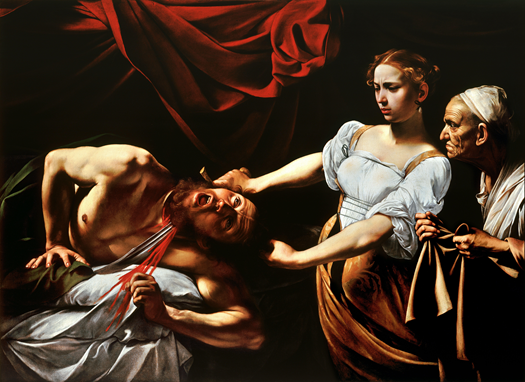
“Judith beheading Holofernes” by Caravaggio, 1598/99
A sign that Oppenheimer writer-director Christopher Nolan was hip to the Thanatos/Eros association occurs early on—before work on the bomb has begun—in the film’s only sex scene, between Oppenheimer (Cillian Murphy) and Jean Tatlock (Florence Pugh). Coitus is interrupted, however, not because Oppenheimer can’t keep it up, but because Tatlock—who’s portrayed as deeply troubled—has the sudden urge to go over to Oppenheimer’s bookshelf and grab the Bhagavad Gita. She then gets back on top, opens to a bookmarked page, and asks him to read the lines in Sanskrit he’d highlighted.
“Now I am become death, the destroyer of worlds,” he translates, which could well serve as the film’s subtitle and which Oppenheimer recites again after the bombs have been dropped on Hiroshima and Nagasaki. But the dire prophesy also redounds to Tatlock, when years later, shortly after Oppenheimer had refused to tell her about the top-secret Manhattan Project, she commits suicide.
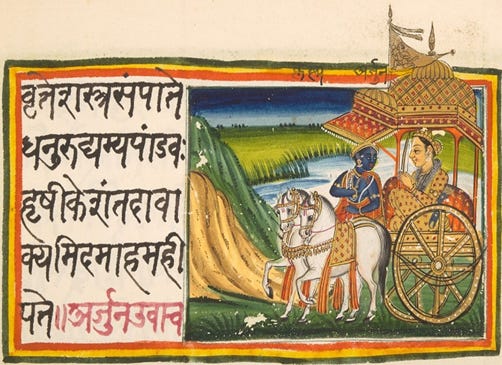
Other lines from the Bhagavad Gita, not quoted in the film, which refer to a “flight of missiles about to begin”
As effective as the coitus interruptus scene may be from a Thanatos/Eros perspective, not all viewers have been thrilled with the juxtaposition. In parts of India, unsurprising given today’s religious fanaticism, the mixing of sex with the sacred Hindu text has provoked a furious response and a call for boycotts and censorship.
Antisemites, meanwhile, must be having a field day with Oppenheimer and the large number of “evil” Jewish scientists overall who worked on the bomb, which of course for Jew-haters provides further proof of the Jewish conspiracy to control the world. Hitler even added a crazy twist to this idiocy by disparaging quantum mechanics—the theoretical basis for the nuclear bomb—as “Jewish science,” but thereby also, as Oppenheimer points out in the film, likely delaying Germany’s development of the bomb and giving the US a leg up. And VE-Day did the rest.
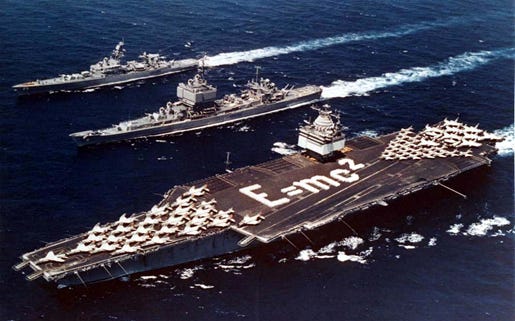
The world's first nuclear-powered task force, with Einstein’s mass-energy equivalence formula spelled out by the crew, 1964 (photo US Navy)
Barbie doesn’t get a free pass from the antisemites either, given that the Barbie doll was created by Ruth Handler, whose Jewishness isn’t spelled out in the film, but the casting of Rhea Perlman gets the point across. Handler, ironically, joins a long list of Jews who’ve bequeathed WASP culture some of its most all-American icons: from Superman and most of the other comic-book super-heroes—thanks to Jerry Siegel, Joe Schuster, Stan Lee, Jack Kirby, and others—to song writers Harold Arlen/Yip Harburg’s “Somewhere Over the Rainbow” and Irving Berlin’s “White Christmas,” “Easter Parade,” and “God Bless America,” to many of Hollwood’s most wholesome and patriotic films.

Ruth Handler, 1961 (photo restored by Adam Cuerden)
So where does this leave the Death/Sex dialectic?
While understandably not as overarching a presence as in Oppenheimer, death in Barbie is arguably even more fundamental to the narrative. Though no one is killed or maimed in the film, “Stereotypical” Barbie’s (Margot Robbie) sudden awareness of her mortality is the film’s major turning point. It snaps her out of her doll-like stupor and sends her on a journey of self-discovery that starts, erotically enough, with a trip to the gynecologist—to learn more about her body and, now that she’s human, her body parts!
Verdict?
In Oppenheimer, Thanatos trumps Eros—collectively, in the up to 226,000 Japanese killed in Hiroshima and Nagasaki, and personally, in Tatlock’s suicide and Oppenheimer’s undying sense of guilt over the genie of mass destruction he’s let out of the bottle. In Barbie, Thanatos awakens Eros from a deep sleep, with the promise of exciting adventures to come for the newly humanized super-doll. So that Barbenheimer, no matter how you look at it, is left in limbo between a dreadful real-world past and a hopeful fantasy future.
Not exactly the recipe for solving the planet’s ever more pressing problems, but on movie screens, at least, a winning combination.
* * * * * * * * * * * *
Thanks to Marc and Sam Milkin for their assistance.